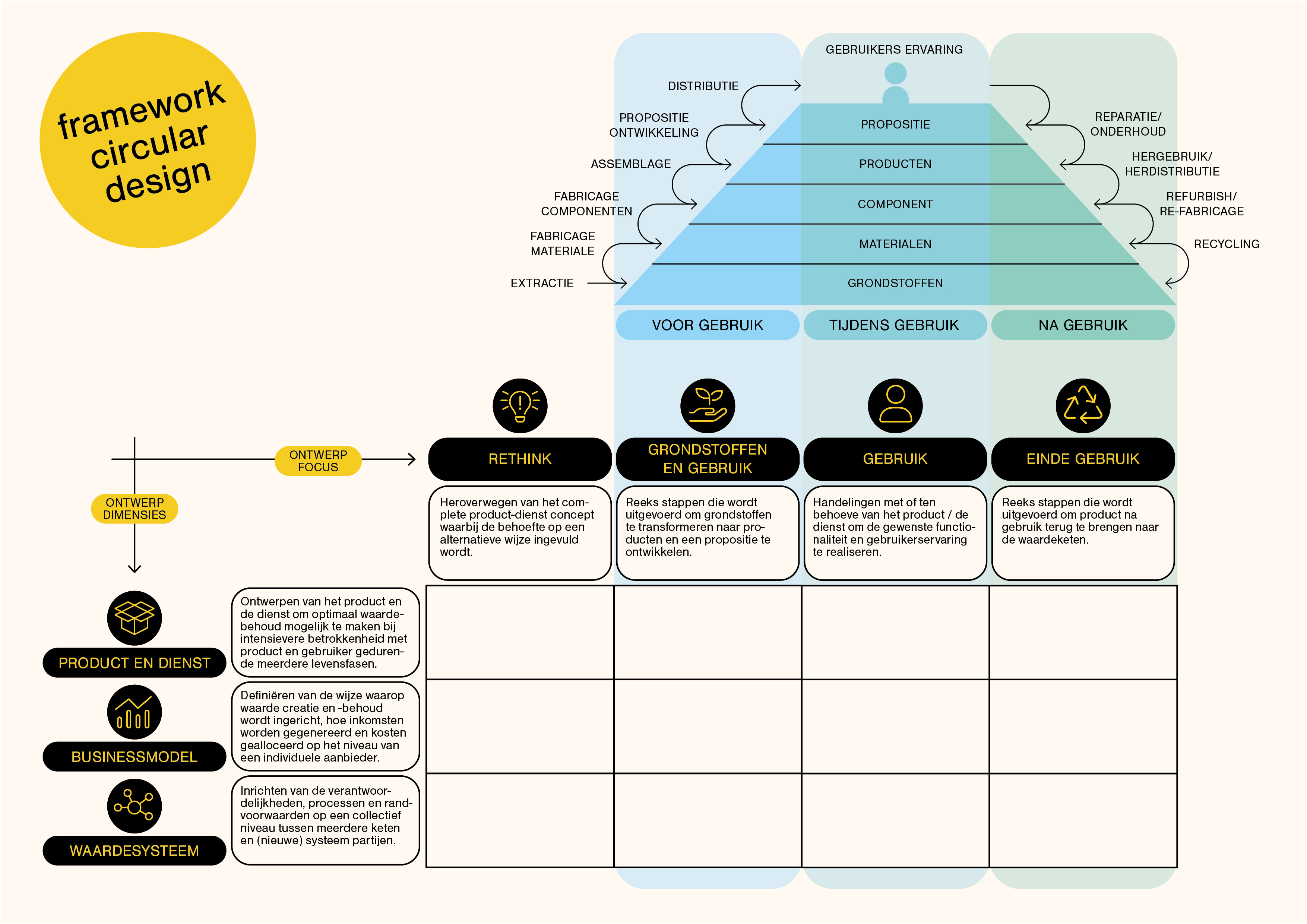
3 x design dimension
Three dimensions apply to integral circular design: the product-service combination, the business model and the value system. In a design process, there is always an interrelation between the dimensions, but in the framework we have described them separately.
The product and service dimension focuses on designing the product with an eye toward optimum value retention. You do this by, among other things, anticipating future applications of the product. And by ensuring that products, components and materials can be reused again in a high-quality manner. In designing the service and process, you facilitate more intensive involvement with the user and other chain parties.
In the business model dimension, you define the way you set up value creation and preservation, how you generate revenue over the entire life cycle and how you alloce cost at the level of an individual provider. How do you as a provider (and other parties in the chain) realize an attractive business case?
These first two dimensions focus on the proposition design of an individual provider. It is usually an iterative process with great consistency between the product-service design and the business model.
The value system dimension focuses on the chain and additions from other sectors. Indeed, some of the circular interventions go beyond the actions of individual companies. They must be set up collectively at the chain level. Examples include setting up an open loop collection system, defining (material) standards or information exchange throughout the chain. Individual companies adopt these agreements voluntarily or enforced by regulations. They then become design requirements on the first two dimensions.
4 x design focus
The design process generally takes place before the introduction of a proposition. In a linear design, the main focus is on raw materials and production. In a design process with circular principles, you consider the entire life cycle. You also pay attention to optimizing the use phase. And you sort for applications of the product, components or materials after use. These focal points are linked to the phases in the Value Hill.
An additional design focus, which actually precedes Value Hill, is rethink. There the question is whether the need that the product fulfills can also be served in a completely different way. Can you deliver the functionality with a different product-service concept? Or can you fill the need in a way that avoids product deployment?
In the framework, we have broken down these different focuses. Thus, we indicate which design topics are relevant for each focus. Good circular design includes, of course, all areas of focus. In practice, you will usually optimize within one of the focuses first.
Implementation of the framework
The framework can be used to elaborate on various design-related topics. Moreover, the structure functions as a kind of checklist for design processes. But the content of the matrix can vary from product to product and is fodder for dialogue.
In the current interpretation, we have made a start to formulate the generic design challenge for each cell.

Download the completed framework
There are plenty of design topics you can plot in the framework. We invite everyone to do so and share it. That's why we also provide an empty version of the framework. Topics that lend themselves to this, for example, are:
- Design guidelines from a new European Regulation Ecodesign for sustainable product regulation (general and by product category);
- Design questions for a specific Extended Producer Responsibility (UPV), for example, for textiles;
- Knowledge question by topic, distinguishing what is available and what is not;
- Available design tools.